Showing posts with label sacred sound. Show all posts

Sunday, 3 June 2012

Kirtan with Upahar at Shekinashram

Butterfly Barn, Sve Dame community, Auroville
 
I am very pleased to tell you about a great evening kirtan taking place the auspicious night of the Venus Transit with Upahar Anand

Upahar, originally from the UK, now divides the year between Italy and Tiruvannamalai in south India, site of Ramana Maharshi ashram, sacred mount Arunachala and a town of spiritual pilgrimage where the transformational energies are strong.

 
I was blessed to attend his kirtan several times during my recent trip and always achieved a wonderful feeling of connection and love. 
Our paths kept crossing. We first met over idlis at the Sheshadri Bhavan in Tiruvannamalai, introduced by Lillah,  friend and fellow Glastonbury yogini who I was visiting.  Then I attended two evenings with Upahar in Auroville where I was a long term guest. 
Sea of souls - Tiruvannamalai
Upahar was excited to know that I was from Glastonbury as he had played the ashram in 2010 and was keen to return, Would I hook him up? Of course!

I hold such strong and positive memories of Sunday morning kirtan, sitting cross legged in Upahar's house, knees touching my neighbours as the room was so full of people, including several familiar faces from Glastonbury.  
 
 
Many people I did not know, nonetheless we were sharing a powerful experience. One morning in late January felt particularly strong, I witnessed an ecstatic sensation something like being part of an ocean, the congregation of singers rising and swelling as a single entity as my heart surged in my chest, carried by the sacred songs. Utterly moved, to tears, several times and I looked around the room and saw that I was not alone.
Fortune also gifted me the blessing of an afternoon session in a temple, the day of my birthday, when I had travelled to Tiruvannamalai, having left Auroville after two months, I surrendered to the lure of the town.

 
Upahar is an accomplished and experienced multi-instrumentalist, adept on harmonium, guitar, drum, vocals and flute.

He has an extensive repertoire of chants and songs; well known bhajans and some interesting less familiar material. Upahar is strong on Shiva and Shiva energies and also weaves sufi influences and poetry into his sessions.
 
Unmissable! Come, share and participate in a field of divine love at a time of amplified celestial vibrations.
Kirtan with Upahar, Shekinashram, Glastonbury Weds 6th June 2012  7pm
Hope to see you there!

Peace and blessings
Jennifer
 

Tuesday, 28 February 2012

New! Yoga Chant group in Glastonbury

I invite you to join me at a new weekly session taking place in Glastonbury as follows:


Yoga Chant
Thursday 11am - 12pm
The Miracles Room, Glastonbury Experience,
High St Glastonbury

Starting 1st March
Contribution £5/£4


Chanting is a powerful way to create joy. To balance, heal and accelerate inner transformation.  As such it is a useful part of our yoga and a yoga in its own right.

For millenia, yogis and rishis of India have passed on sacred formulas through vocal repetition, aspiring to higher states of consciousness and to preserve and transmit wisdom. I have been blessed to spend extended  periods in India studying mantra and sutra and have incorporated chanting into my personal yoga. I offer these sessions so that you may benefit as I have.

Such as :

- Calmness and relaxation Standing down from the stress response, soothing the adrenals, regulating heart rate, blood pressure and hormones.

- Quiet mind Thoughts are stilled while we are chanting.

- Empowerment and confidence It  feels good to use the voice with awareness, focus and intention.

- Energizing the spiritual body Chanting clears the nadis (channels where life energy flows) and bathes the cells of the body with positive energy.

- Healing and re-balancing Mantras act as prayers; as we recite them we create a  powerful intention of healing. In ayurveda, mantra is regularly prescribed to heal physical symptoms.

- Creating and manifesting Mantra can be directed to specific areas of life where we might wish for improvement, they are the original positive affirmations!

- Inner peace  Many mantra are formulated specifically to create inner peace within the practitioner.

- A gift to humanity As we become more peaceful, we radiate peace into the fabric of the universe so assisting the whole of  humanity.

- Eternal wisdom and liberation We may not understand the subtleties of the Sanskrit, but we are imbuing ourselves with ancient yogic wisdom which percolates through to the subconscious level. Overtime, this creates conditions for moksha or enlightenment.

- The joy of sharing Positive energies generated by chanting are amplified in a group and there arises a wonderful feeling of wellbeing from sharing and belonging.

We will chant a selection of short, simple sanskrit verses that I use myself and have been authorised to teach, from the classic texts of India including the yoga sutras of Patanjali, the Vedas and the Upanishads. 

These will be relaxed, informal sessions, and all are warmly welcomed, no previous experience of yoga and/or yoga chanting is required.

I provide written sheets with the chants and meanings and we will progress at a pace that supports everyone.

The Miracles Room is a lovely venue; spacious and tranquil, flooded with natural light and conveniently located on Glastonbury High  Street, close to the Market Cross.

Sessions are drop-in, so no need to book in advance, however you are welcome to call  me on 07779 807089 or email jennifer@divine-yoga.org with any enquiries.


I look forward to chanting with you!

Om shanti, shanti, shanti

Jennifer


Wednesday, 15 February 2012

The streets of Glastonbury are paved with Love

Snowdrops in Glastonbury Abbey
Early spring in Glastonbury; I have flown back from India but return nightly in my dreams to Auroville and Tiruvannamalai.

A close friend shared a confidence, that upon her return from an extended visit to south Africa, she asked Glastonbury to show her whether or not she still belonged in the town. A good question, and although I didnt consciously voice it, it was seeded within.


The wintry weather of recent days has been a challenge, a snow storm greeted me at Heathrow, I understand that I was fortunate to have travelled home smoothly and safely with no delay or inconvenience - an act of grace that I give gratitude for.

Mornings are sharp and cold, with the sun sometimes breaking through for an hour or so and temperatures resolutely sub-zero.

I've been taking the cue from Kitty, who seems permanently welded to the duvet and giving myself all the sleep and rest my body is asking for. So when I received a facebook message yesterday suggesting a 9:30am walk,at first it seemed quite unreasonable.
.
Healing sound circle
I swiftly reconsidered, it was after all St Valentine's day and I had been invited to spend time with a fabulous friend.

We meandered around the Tor and made our way slowly into town, stopping at the wholefoods store for carrots, kombucha and raw chocolate, which we shared contentedly on a bench in the Abbey grounds, facing the ruins with the sun in our faces, surrounded by snowdrops.


I took a full hit of the potent superfoods, boosted further by a generous measure of Horny Goat Weed elixir. I was feeling elated, giggly and excitable and so as midday chimed we scrambled back into town and gathered outside St John's Church on the High St as part of a sonic love circle; uttering the cosmic sound ahhh in unison. It was perfect, our individual voices blending and merging, an expression of harmony and oneness.

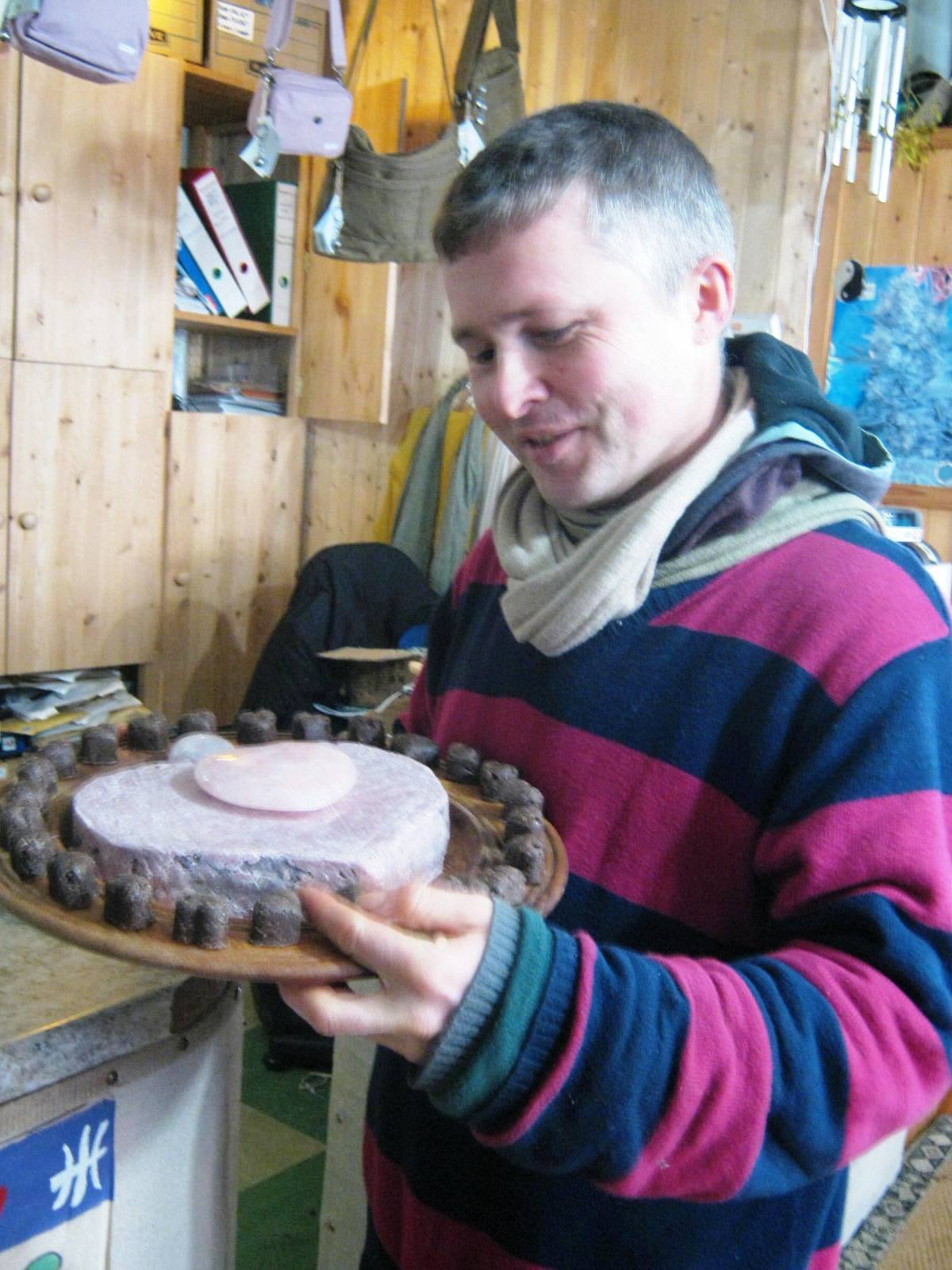
We hung around afterwards chatting with friends and catching up, it was great to be welcomed back on such an auspicious day. More elixir was administered and someone produced a batch of  funky homemade hats that were passed around and tried on, it was a very Glastonbury moment.

The hemp master adoring his creation
In the afternoon I visited Free Love Cannabis who was handing out cake and truffles from Hemp in Avalon, his Valentine offering. Free loves an audience and with a full shop he felt inspired to perform some of his poetry and speaking on the subjects of divine consciousness, Gaia, forgiveness and purification, a kind of impromptu satsang.

I took my guitar along and occupied a corner of the floor beside an indoor water shrine and played a set of songs on the theme of love, mostly from the Osho ashram in Pune.

Everytime the shop door opened, more and more familiar faces would enter, I started to feel bliss rising as I acknowledged my happiness and how good it felt to be seeing so many friends in one day that was unfolding magically.

As the sky darkened and dusk arrived, the merriment in town continued with talented poets and story tellers performing during the evening. There was a clear understanding that we were celebrating St Valentines day not just on the level of romantic love between couples, but also the greater love, the divine cosmic consciousness that daily is becoming more apparant in our lives.

Walking home I basked in satisfying positive feelings and contemplated my good fortune.
.
Soul family
I remembered  how Glastonbury comes to life in the spring, how there would be planned community celebrations as well as spontaneous happenings that would lead up to the crescendo of summer solstice and beyond.

Our community is powerful, connected and possibly unique. I gave myself credit and acknowledged that I too was one of the talented creative people I admire and respect and that moreover Glastonbury was clearly showing me that  I did belong - so many friends manifesting on one day to welcome me home was the proof of that.

I feel so honoured and happy to be received so lovingly in the bosom of Avalon and excited about making my contribution in service to the town in the coming weeks and months.


May we overflow with love in all forms and frequencies 

Jennifer

Tuesday, 15 November 2011

Notes from Anandashram

Om sri ram jai ram jai jai ram, sri ram jai ram jai jai ram

Approaching the shrine of Papaji
This morning I was roused from sleep by a devotional male chorus, chanting the mantra that is the core spiritual practice here at Anandashram. 

The ashram's beloved founder, Swami Ramdas, (affectionately referred to as Papaji - dear father) is reputed to have achieved enlightenment through this method and accordingly devotees uphold the practice.

The ram nam is sung continuously from dawn 'til dusk alternately by male and female bhaktas. The practice is rotated daily between the three mahasamadhi shrines of Papaji, Mataji and Swami Satchidanda.* Such a beautiful way to meet the day; I lie in bed, eyes still closed and smiling inside. 

I might equally be stirred awake by the lowing of the ashram cows - also lovely. With names such as Bhavani (consort of Shiva), Bhagavati ( enlightened teacher), Vidya (knowledge), Mala (garland) these ladies are well cared for. 

I visited the goshala (cowshed) during my first days here, observing tidy bales of straw, rubber boots organised neatly in pairs and a mother tending to her newborn calf.

Goshala
I am housed in a concrete block, six rooms in a row sharing two bathrooms. Rooms are clean, light and basic: narrow wooden beds, a desk, a chair.

As the only foreigner I get to bear close witness to the daily habits and rituals of the Indians. In the absence of western comforts and conveniences it can be helpful to watch and learn how to get things done.

For example, there is no laundry service, very much a personal challenge! The common practice is to soak one's clothing in a bucket filled to the brim with water and to leave this overnight in the hallway.  Items are rinsed through the following morning and hung on the indoor clothes line in the common area. Larger items such as saris and bed linen are spread flat on the gravel outside in the strong, bright sunlight. 

Naturally enough the toilets are Indian squat style and the bathing facilities are equally straightforward: cold tap, bucket and jug. This suits me well although I am careful to time my sessions, scurrying along the corridor wrapped in a sheet (no bathrobe!) to avoid encountering and embarrassing any of the men.  In the warm humidity of Kerala morning and evening baths feel necessary; it gets quite dusty on the roads and paths.

Peeping into the bhajan hall
It surprises me that the accommodation is mixed as so many of the ashram activities are segregated by sex. Separate queues and seating in the canteen, and also in the main bhajan hall. 

I am thrilled to find myself belonging to a community of women. Eating together, singing together and sitting out together in the warm evenings after dusk. 

It doesn’t matter that I don't understand their conversations. It is enough to be with them. Absorbing with delight the details of their dress, their handwritten prayer books, the way they conduct themselves. 

We sit close together, cross legged on the floor, elbows and knees touching, I don’t mind the lack of personal space: spending intimate time with Indian women is a rare blessing.  

I have learned some gentle feminine etiquettes, such as dressing my hair with fresh jasmine flowers.  It looks delightful and acts as a natural air freshener, gently perfuming one’s environment with every turn of the head.  I have also acquired the habit of carrying a cotton handkerchief, folded and tucked into my churidar(wide cotton trousers). 

These are mainly ladies of a certain age, in their fifties, sixties and seventies. At this stage of life freedom from raising children and/or work permits them to undertake yatra (spiritual pilgrimage) and visit ashrams. 

There is plenty of smiling and nodding as we acknowledge each other. Any conversation is dependent on their level of English. As, alas, I have no Hindi. Typically the questions come Which country?  or Coming from? Followed closely by Your good name? Married? First visit to India?

Prema and Nirmala introduce themselves
Most of ladies I spoke with had been visiting Anandashram regularly, many for decades as disciples of the original guru.  

In the tranquility of mataji’s peace garden, sisters Prema and Nirmala ignored the signs requesting silence and told me of their annual eight day visit from Coimbatore. 

Every year we are coming, it is most important to visit ashram, stay at least one week. This very calm place, life so busy, no?


Jyoti, a plump and chatty retired school teacher from Hyderabad likes to sit next to me during the evening meal. She scours the dining hall looking for me and settles happily by my side, usually bringing extras that she has mysteriously acquired, carried in a stainless steel tiffin. Chapattis, bananas and sweet treats such as ladoo and pak .

Mealtimes are announced by the clanging of a large bell outside the canteen. Guests and residents dutifully form lines: men to the left, women to the right and file in. As we are in South India, rice is the basis of every meal prepared in the endless creative variations: idlis, dosa, upma for breakfast and huge avalanches of plain rice served with vegetable sauces at lunch and dinner, supplemented by milk and curd from the dairy. 

Communal canteen
The schedule at Anandashram is full with chanting and singing of all kinds. There is no obligation to attend but I pretty much love it all! I have joined in the chanting of ram nam, slowly pacing the shrine rooms of the departed gurus and clapping a steady rhythm. 

Yesterday morning I sat in on Om namaha shivayah, a favourite chant of mine, sung unaccompanied by a petite lady in her seventies, her solo voice was raw, wavering and deeply soulful. Definitely the most powerful and memorable rendition I have heard so far.

Possibly my personal highlight has been listening to the Hanuman chalisa, sung by the women, accompanied by harmonium. I am keen to learn this epic poem for myself and twice I took a copy of the words along but found the singing so blissful and enjoyable that I chose to simply relax and absorb the vibrations.

I’ve drawn a few tentative conclusions about my time here:

Simplicity in practice. Bhajan and mantra sound very good sung solo, unaccompanied – or minimally accompanied: musicality comes second.

Letting go of learning I didn’t have a chant sheet or song book and the bhajans were complex, I had to forget about trying to learn them. This focused me in the present moment and enabled me to receive, receive, receive.

Singing with women This is quite personal to me, I feel so safe and nourished in an all female setting. I am keen to explore this further.

Raghupati Raghav Raja Ram (Ram Dhun) Anandashram by divine yoga

Blessings and pranams

Jennifer 

*Further information on the spiritual lineage at Anandashram

Tuesday, 11 October 2011

Singing my yoga: taking music lessons in Rishkesh

This alluring sign caught my attention

I stared at the enormous electric air cooler that dominated the blue cube of a room where I have been coming daily for singing lessons. A powerful roar was emanating. How was I going to hear myself over that?

Chandra my teacher, pretty, petite and quick of mind had imported it for my comfort. I didn’t wish to appear ungrateful and refuse her kindness; I suspect she was paying money to rent it. 

In any event, it would just add another layer to the sound sandwich that is India.

Chandra teaches singing, tabla and sitar from her home close to the main Laxman Temple in Rishikesh. Access is via a set of steep, narrow concrete steps lined with saffron robed sadhus. They spend their days sitting outside with their alms bowls.  From the teaching room I could hear a very regular chink of coins being received and the ubiquitous salution Hari Om!  

We sit cross legged on a red patterned wool rug and Chandra operates a harmonium to accompany me.  I am practicing vocal exercises:  variations on scales and arpeggios Sa Re Ga Ma Pa Da Ni Sa. This takes up the entire hour.  My brain is quite tired by the end from the concentration. 

I enjoy it very much, as a teacher, it feels great to relax and receive instruction. And although Rishikesh is all about yoga and there are countless options for classes, I am well established with my daily asana and  so have the time and resources to spend on other things.

I am going deeper and deeper into bhakti yoga and kirtan and sacred singing of all types. So this a great way to improve and grow in confidence as a singer. Private tuition is extremely affordable (200 -300rs  per class) and I record the sessions onto my mp3 player so I can practice in my room or when walking about town.  

Bansi's teaching room
I have a second teacher, a brahmin, named Bansi. I would guess him to be in his seventies. He is extraordinarily youthful and energetic of spirit and has a kindly presence.

I was standing in the main square pausing in the shade a few days ago when I noticed a sign outside a men’s hair salon. 

It turns out that the barber, Rakesh,  is a longterm student of classical flute who is happy to guide new pupils to his master.

Hence daily I take myself to a second noisy room (building work below, monkey fights above) to sit on another rug (old, beige, dusty) and practice a different set of vocal exercises: mantra  or prayer.   

Bansi is very laid back. On my first day he asked me what I wanted to learn. To practice the yogic chants I had been given five years ago and to move onto longer mantra I replied. 

From a large wooden cabinet with glass doors, Bansi selected a slim book, Sivananda Ashram Daily Prayers produced by the Divine Life society. This is published locally; the ashram is located just across the river at Ram Jhula.  Another very solid harmonium was taken down and the familiar, comforting warm drone once again accompanied me.

We started at the very beginning of the book, with a wonderful guru stotrum which is spoken at morning prayers.  Then we practice the classic mantra that will be familiar to most yogins and bhaktas: Poornamadah, Sahana vavatu, Sarvesham swastir vavatu, Tryambakam yajamahe  and more. 

Guruji!
I love the latter, after ten repetitions or so I begin to feel fire in my belly! This is also a favourite of Bansi who tells me with smiling eyes This mantra to Shiva is meant to save your life- from Devils!  Useful!

These sessions are so very helpful, in terms of correcting anglicisms that have crept in my pronounciation.  And in reminding me of correct intonation patterns.  I love the sing song lilting melodies, Bansi sings with a great lightness and obvious, easy joy and he is very adept at tabla too.

So my days are pretty full with lessons and self-practice.  I have started attracting more singing opportunities: the law of attraction in action. 


A young Israeli guy spotted my guitar bag and invited me to a night time jam session at the Bombay Guesthouse. I poked my head in during the day to check it out and was met by a wall of ganja smoke and giggles, so I probably won’t go, but I was happy to be asked.

I bumped into someone I met in Arambol in Goa, like me a health freak. She is staying at the Pyramid Guest House on account of their sprouts and spirulina. She thought it would be cool to start a singing satsang on the beach by Ram Jhula. I agreed, it was a good idea. 

Tiny temple courtyard where womens bhajans are hosted
Finally, I was walking past a tiny blue temple heading out of town last night as dusk was falling. I was mesmerized by the enchanting sounds of a women’s bhajan group.

I scrambled down some stairs following the sounds of bliss. In a small covered courtyard in front of a shrine were women of all ages, from two to eighty two, chanting kirtan together as the male priest performed puja.


I was beckoned in and handed a large pair of manjira hand cymbals. How amazing! I couldn’t follow the chants but it was enough to be present and so there I sat, on a cool stone floor, in the nurturing presence of such beautiful women; sisters, cousins, aunties, daughters and granddaughters, chiming and clapping with love in our hearts as the sun went down.

I am looking forward to many more musical adventures as my time in India unfolds.

Om shanti, shanti, shanti

Jennifer

Wednesday, 20 July 2011

Singing for the Inner Child: New Workshop

Free child in nature
The inner child to me represents the most alive and feeling part of myself. A deep joy to be present with.

My inner child communicates with me through dreams, creativity and play and through strong emotion. Feeling scared, threatened and vulnerable are all signs that I am connected to this soft and sacred part of myself and I honour and cherish all my precious feelings.

If overwhelmed, threatened or rejected my inner child might withdraw, shut down, hide away. This produces an immediate deadening or numbing of my consciousness and can be accompanied by reactive, negative, self-destructive behaviours.

Through years of healing and self-discovery across many modalities I am really, really pleased to me mostly living from a state of self-connection with the occasional disconnect; I recognise that for most of my life the opposite was  true. What a gift to be living and co-creating with a divine, magical child!

My inner child responds positively to nurture of all kinds: a clean and comfortable home, the sanctuary of bed and bedroom is especially important. Opportunities to play in nature, to touch and feel the textures and sensations of leaves, twigs, stones and water.

Most of all my inner child requires for me to create a loving environment within myself. I need to emanate a vibration of kindness, acceptance and compassion and flood every cell of my body with unconditional love. Negative emotions directed from myself to myself are especially toxic to the inner child who is vulnerable to shame, blame, criticism and judgement.

I surround myself with loving friends, in effect a soul family, who reflect and amplify loving feelings back to me and encourage my inner child to stay present in the world. My inner child is learning that the world is a safe, enjoyable place to be. It is ok to self-express, my contributions are valuable, I am loved and appreciated: I am good enough and I matter!

African Lullaby workshop June 2010
A huge, huge part of my healing journey has been through patient and persistent repetition of positive affirmation; reprogramming core beliefs. 

And singing, the inner child loves to sing. I have gathered a wealth of devotional and medicine songs from many traditions, ancient and modern from all over our beautiful planet.

Songs mostly learnt in singing circles, passed orally. Often in nature, blessed by sacred elements: the ocean, sunset, around a fire.

I have selected a number of songs to pass on, with the focussed theme of Singing for the Inner Child. This workshop is not offered as a healing or as medicine, although I wish for all who attend to experience benefit. My intention is to gather a small group of people within a safe, held space. To create the conditions for the inner child to show up and receive nurture and positive affirmation.

Singing strengthens immunity, gladdens the heart and these simple songs take one out of the mind and into the heart. It is beautiful to be open, trusting and to share with others.

Musical talent or prior experience is definitely not a pre-requisite! We come as we are and all are welcome! I invite you to listen, receive, relax, participate as you feel appropriate.

This workshop is offered with love, in service to love and for the highest unfoldment of good for all.

I hope you can join me at  New Holistic Camp 2011 where I will be holding this circle during the gathering.

This workshop is likely to be repeated in Glastonbury in late summer. Keep an eye on my schedule for updates.

If you would like me to bring this workshop to your event, gathering or camp I welcome invitations! Contact me or leave a comment below.

New Holistic Camp website www.new-holistic.co.uk

Further resources for Inner Child work:

Louise Hay Forgiveness and Loving the Inner Child audio download
Inner Child Tarot
Music of Shania Noll
Books by Charles Whitfield
R E Jenemy's YouTube channel

Friday, 3 June 2011

Shimshai plays Glastonbury : Concert review

The gig opened offically with the chanting of three aums, by which time a high vibrational aura of incense, raw chocolate,  spring water,  breastfeeding babies and bare feet was well established. The clean, pure and spiritually inclined of Glastonbury gathered to celebrate life, music and the divine connection last night at United Reform Church on the High Street.

I enjoyed being able to saunter into town into such a modest venue and be entertained and uplifted for a very reasonable fee by a master musician whose commitment and creativity greatly inspire.  Shimshai's music is  profoundly important; he is an outstanding lyricist whose talent lies in precisely and succinctly identifying the spiritual truths of our time; creating fresh, memorable songs celebrating our reconnection to nature and spirit, consciousness awakening  and emotional healing.

I found myself surrounded by numerous friends,  many of whom compose, perform and lead devotional song in their own right. Supporting was the much loved local collective Avalon Roots,  headed by Green Bean, laying out soulful, funky smooth grooves. Green went on to provide percussion for Shimshai who was also joined on flute by Harmony (Hilary Davies) highly accomplished Cambridge music graduate who is very active within the community, teaching, holding singing groups and gigging with her latest band Tatterdemalion locally and on the alternative festival circuit.

Shimshai flowed his material together and is clearly a practiced a performer. Many of his compositions have become instant classics; spiritual anthems of the new age. He travels extensively  with an enviable international itinerary of festivals, retreats and sacred sites.  Further info on his website. If you are quick, you can catch him at Sunrise Celebration this weekend in Somerset.


I have added a link below to my current favourite Shimshai track, performed at the Dead Sea, how amazing is that?

Wednesday, 7 April 2010

Ravi Shankar celebrates his 90th birthday


Let us celebrate the birthday of Ravi Shankar, esteemed and renowned sitar player, who turns 90 today.

Thanks to Shankar's pioneering approach and prolific output, Indian classical music has been well assimilated into our cultural palate. We have availability of the pure form through concerts, kirtan and audio. The taste of India that Shankar gifted us has filtered into our consciousness through the vastly popular fusion styles from the chic chillout lounge vibes of Buddha Bar, to the New Age devotional Bhakti fusion of Deva Premal and the joyful, exuberant dance orientated compilations of yoga diva Shiva Rea.

Famously George Harrison studied for six weeks in India with Shankar. They met in London after Harrison was introduced to Shankar's work by The Byrds, who were fans of his sound. Shankar has received numerous international prizes, awards, teaching seats and accolades during his long and diverse career and has influenced both eastern and western musicians across popular and classic genres. The full extent contribution is surely beyond measure.

Enjoy this video footage of Shankar instructing Harrison on the sitar in Srinagar


Visit Shankar's official website http://www.ravishankar.org/

Catch this documentary on BBC iPlayer chronicling Shankar's career
(available until 10th April 2010)
http://www.bbc.co.uk/iplayer/episode/b00rs4s9/World_Routes_Ravi_Shankar_Birthday/

Monday, 21 December 2009

The twelve names of the sun

With cold feet and a warm heart, I have just returned from watching the midwinter solstice sun emerge from the night sky as it rises over Glastonbury Tor, a well observed ritual within my community. Sun worship is an ancient practice; early humans evolved spiritual beliefs and rituals that reflected their relationship with the natural world, and created symbols and deities representing the sun as a symbol of consciousness.

The sun is referenced liberally throughout ancient Indian texts and in the physical yogic tradition, we have surya namaskara, sun salutations, which are performed daily before sunrise. It is a flowing breath linked sequence of postures that generate prana, purifying and rejuvenating the practitioner.

I love the timelessness of surya namaskara and how, as we move through the poses we are connecting ourselves with thousands of years of yogic wisdom and honouring our connection to the rythms of nature. On a study trip to India three years ago I was introduced to a set of bija (seed) mantras that accompany surya namaskara, thus giving a complete and powerful spiritual practice. The sun is named in between each of the thirteen rounds, praising its aspects as follows:

Om mitraya namaha – the sun as friend
Om ravaye namaha – he who shines
Om suryaya namaha – dynamic aspect
Om bhanave namaha – remover of darkness and illusion
Om khagaya namaha - by whom we measure time
Om pushne namaha - who bestows strength and nourishment
Om hiranyagarbhya namaha – the golden germ of all life
Om marichaye namaha - Lord of the dawn, he who illuminates
Om adityaya namaha – the cosmic mother, boundless and inexhaustible
Om savitre namaha
- vivifying and stimulating
Om arkaya namaha – source of life and energy
Om bhaskaraya namaha – revealing all truths and showing the path to enlightenment

The practice concludes:
Om sri savitre surya narayanaya namaha – salutations to the universal spirit

Using mantras in conjunction with the physical form allows us connect to and awaken these divine qualities and thereby embrace the tremendous strength and potential that exists within.

Wednesday, 8 July 2009

Sanskrit - the holy language of yoga

Following class today a student enquired as to the language of yoga, was it Hindi? Hindi as a language relates to the Hindu religion and is the most common language of modern India, widely spoken and understood across the subcontinent and now echoing around the globe via countless Bollywood movies. Whereas Sanskrit is the ancient, scholarly language of classical Indian art, music dance, philosophy, spiritual tradition and therefore yoga. Seminal texts such as the Upanishads, the Vedas, Patanjali’s yoga sutras and more.

Sanskrit is the language of spoken and sung devotion. Mellifluous mantra, bhajan and sloka (chants, songs, prayers) are all recited in the medium of Sanskrit. Most of us are familiar with Om, the sacred syllable said to be the vibrational seed that creates and recreates the universe. Or the eagerly implored repetitions of Hare Krishna! Perhaps a longer mantra used to begin or conclude yoga practice. It is a warm rich language, pleasing to the ear and uplifting in its vibration. For millions of devotees, yogis and academics it is the language of God.

On visits to India I frequently encounter fellow yogis who are studying Sanskrit; the mesmerising, swirling shapes of the written form and the voluptuous sounds as it is spoken aloud. I have absorbed some knowledge of Sanskrit through my yoga studies: committing Patanjali’s yoga sutras to memory at the insistence of my teacher in Mysore. Lino Miele’s patient, faithful counting and naming of the poses whilst leading the primary astanga vinyasa series. Blissing out chanting devotional bhajans with a group of plump Indian housewives at the Neasden temple in north London. Reading texts for ayurveda, tantra, Buddhism….

I prefer to use Sanskrit terms for yoga poses during class. Hence seated forward bend paschimottanasana, triangle pose trikonasana, cobra pose bhujangasana and so on. In this way one connects oneself and ones students with the ancient, esoteric practices that have shaped and preserved our precious yoga.

Follow the link below to hear some wonderfully uplifting Sanskrit chants from the Padma Purana.

Thursday, 30 April 2009

Goma return to Glastonbury


I am thrilled that Goma will be returning to Glastonbury this Bank Holiday weekend. They will be performing sacred chants and mantras from India, inspired by their devotion to their guru, Babaji. I find their music utterly mesmerising and uplifting, from the opening notes one finds oneself absorbed into bliss. Highly recommended.
Event details as follows:

8pm Saturday 2nd May 2009, West Pennard Village Hall nr Glastonbury, Somerset

Sliding scale £6 - £10; £5 concs

Further information: call Uma 01749 812151

Follow this link to hear Goma sing Shiva Maheswara from their 1998 album River of Grace http://www.youtube.com/watch?v=0grkLDaZlEk

Order Goma CDs online http://www.soundtravels.co.uk/advanced_search_result.php?keywords=goma

Monday, 8 December 2008

Goma in concert - review

Last Saturday I attended a concert by the family group Goma. Goma are talented spiritual musicians who offer their work in the name of their guru (teacher), Mahavatar Babaji. The programme consisted of mantra (prayer) and bhajan (song); both aspects of Bhakti yoga, the yoga of devotion. Music flowed seamlessly for 2 hours, the singing accompanied by traditional musical instruments played by Gopal Hari & Ambika (pictured) and their sons. The evening was well attended by friends and familiar faces from Glastonbury; it was an uplifting and rewarding experience and I look forward to their next local appearance. Below is a link to Goma's schedule, hosted on the main Babaji UK website, where you also can find further information about Babaji. Audio CD's of Goma's music are available for purchase from Hemp in Avalon, Marketplace, Glastonbury.

http://www.ombabaji.org.uk/calendar.htm

Friday, 31 October 2008

Kavi in concert at the Shekinashram

Tuesday evening I attended a wonderful and uplifting concert at the Shekinashram in Glastonbury. Kavi is a soulful singer and musician and for a little over an hour he delivered a beautiful and intimate acoustic set of his songs. The themes of his work are divinity, bliss, self-knowledge and love. I would recommend that you check out his work. I was particularly touched by his humility and grace.
This is a link to his MySpace page :
www.myspace.com/kavihockaday
Enjoy!